Quick picks
| App | Best for | Price | CBT program | App Store rating |
|---|---|---|---|---|
| Tinnitus Buddy | Free notched sound therapy and a private journal | Free. Pro is $6.99/month or $49.99/year | No (breathing exercises only) | 4.3 (6 ratings) |
| ReSound Tinnitus Relief | A free sound library with guided relaxation | Free. Premium is $6.99/month or $69.99/year | Relaxation exercises and a weekly plan | 4.7 (19,376 ratings) |
| MindEar | A structured CBT program with sound therapy | Free download. Plans from $5.99/month | Yes | 4.5 (466 ratings) |
| Tinnibot | CBT through an AI chat companion, backed by a 2026 trial | $14.99/month or $69.99/year | Yes (chatbot) | 4.6 (16 ratings) |
| myNoise | Tuning a soundscape until it blends with your ringing | Free to try. Unlocks from $14.99 to $19.99 | No | 4.8 (1,184 ratings) |
| Oto | A program your audiologist sets up and follows | Through a participating audiology clinic | Yes (short guided sessions) | 4.7 (849 ratings) |
Prices and ratings are from the US App Store on October 31, 2026. They change, so check the listing before you subscribe.
Masking or retraining: what a tinnitus app can do
Tinnitus apps do one or both of two jobs. Knowing which one you need is the fastest way to pick.
- Sound therapy makes the ringing less noticeable right now. A steady background sound lowers the contrast between your tinnitus and silence, which is why ringing feels loudest in a quiet bedroom. The 2026 US clinical guideline from the American Academy of Otolaryngology lists sound enrichment as an option for persistent, bothersome tinnitus.
- CBT makes the ringing bother you less over time. Cognitive behavioral therapy works on the worry, sleep loss, and attention that keep tinnitus in the spotlight. The same guideline recommends CBT for persistent, bothersome tinnitus, a stronger rating than it gives sound.
App-based CBT now has trial evidence of its own. In a 2026 randomized trial in JAMA Otolaryngology, 60 adults used either a prototype CBT and education app or a sham app for 16 weeks. The real app group improved about 20 points more on the Tinnitus Handicap Inventory, and the gain held at 24 weeks. A second 2026 trial of 105 adults found that Tinnibot, a tinnitus-specific CBT chatbot, produced a clinically meaningful drop in tinnitus distress and better sleep after eight weeks.
Two other features show up in many apps. Notched sound removes the pitch of your ringing from the sound you play. Early studies were promising, but controlled trials have been mixed, so treat it as something to try rather than a proven treatment. Tracking lets you log loudness next to sleep, stress, and caffeine so you can see what actually moves your tinnitus.
The 6 best tinnitus apps for iPhone
1. Tinnitus Buddy: best free app for notched sound and tracking
We make this one, so weigh our take accordingly. Tinnitus Buddy is built around finding a sound that fits your tinnitus. You describe your ringing, match its pitch with a short tone test, and hear a masking sound with that frequency notched out. If it does not help, you swap to another sound with one tap.
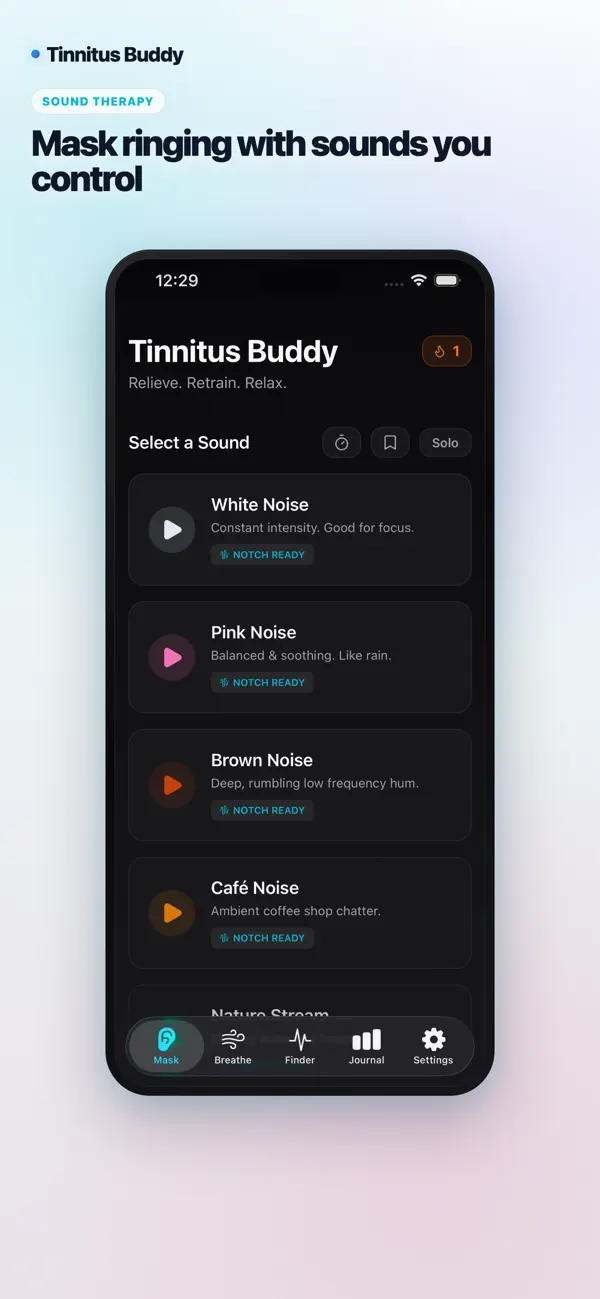
- Free: 28 masking sounds (seven noise colors, rain, ocean, fans, a plane cabin, and more), mixing up to six sounds, the Frequency Finder, the notch filter, box breathing, and a journal with seven days of history.
- Pro ($6.99/month or $49.99/year): keeps playing with the screen locked, including the notch, plus a sleep timer, saved mixes, full journal history, longer trends, and no ads.
- Private: no account needed, and your journal stays on your phone unless you export it.
- Good to know: iPhone and iPad only. The free version shows ads, it has no structured CBT course, and it is a newer app with few ratings so far.
2. ReSound Tinnitus Relief: best free sound library from a hearing brand
Made by hearing aid maker GN ReSound, this app has more App Store ratings than any other on this list. You build soundscapes from environmental sounds and short pieces of music, then add guided meditations, breathing exercises, and imagery for sleep and stress. A short questionnaire creates a weekly plan, and a Learn section explains causes and common therapies.
- Price: free, with an optional premium subscription at $6.99/month or $69.99/year.
- Good to know: it focuses on sound and relaxation rather than tracking, and the app was last updated in May 2025.
3. MindEar: best guided CBT program
MindEar was designed by audiologists, psychologists, and researchers to teach CBT skills for tinnitus. Alongside the program you get a sound therapy library, guided meditations, a podcast series on sleep and breathing, an AI chat coach, an in-app hearing check, and a free 15-minute call with a tinnitus expert.
- Price: free to download, with plans starting at $5.99/month. All-access plans cost more.
- Good to know: the plan list is long and confusing, so read what each tier includes before you pay.
4. Tinnibot: best CBT app with trial evidence
Tinnibot comes from the same team as MindEar and delivers CBT through an AI chat companion, along with soundscapes, meditation, and journaling. In a 2026 randomized trial against a general mental health chatbot and a waiting list, only Tinnibot produced a clinically meaningful drop in tinnitus distress, and it also improved insomnia.
- Price: $14.99/month or $69.99/year.
- Good to know: you learn by chatting with an AI, which suits some people more than others.
5. myNoise: best for fine-tuning a sound
myNoise is not a tinnitus app, but people with tinnitus love it. Its 350+ soundscapes come with sliders for each frequency band, so you can shape a sound until it blends with your particular ringing instead of fighting it. It is built for long listening sessions.
- Price: free to try, with paid unlocks from $14.99 to $19.99.
- Good to know: it has no CBT program or symptom tracking.
6. Oto: best if your audiologist offers it
Oto pairs calming sounds and a sleep timer with short CBT-based sessions of 5 to 10 minutes and lessons about tinnitus. Your audiologist sets up your account, and you can review your progress together.
- Price: available through participating audiology clinics.
- Good to know: you cannot sign up on your own, so ask your clinic whether they offer it.
How to choose the right tinnitus app
- You cannot fall asleep: pick a masking app that keeps playing with the screen locked and has a sleep timer, such as Tinnitus Buddy Pro, ReSound, or myNoise.
- Your ringing is a clear single tone: match your pitch first. Try our free tinnitus frequency finder, then test notched sound in the app.
- Tinnitus makes you anxious or low: choose a CBT program. MindEar and Tinnibot work on your own, and Oto works through an audiologist.
- You want to find your triggers: use a journal for two weeks and compare loud days with your sleep, stress, and caffeine.
- You also have hearing loss: book a hearing test. Hearing aids often reduce tinnitus on their own, and hearing aid brand apps can stream sound straight to them.
How to get results from any tinnitus app
- Keep the volume just below your ringing. You should still hear a little tinnitus under the sound. Drowning it out is not the goal, and long sessions at high volume can harm your hearing.
- Use it in the same situations every day. Bedtime, a quiet office, or the drive home. Give one setup two weeks before you judge it.
- Track how much it bothers you, not only how loud it is. A drop in distress is real progress even when the pitch stays the same.
- Pair sound with a skill. Sound helps in the moment. CBT and cognitive reframing are what make the hard days less hard.
When an app is not enough
See a doctor or audiologist if your tinnitus pulses with your heartbeat, started suddenly, is in one ear only, or comes with hearing loss, dizziness, or ear pain. Our guide on when to seek medical care for tinnitus covers the warning signs. If tinnitus is affecting your mood so much that you have thoughts of harming yourself, call or text 988 in the US to reach the Suicide and Crisis Lifeline.
How we picked these apps
We started with the apps that come up most when people ask for the best tinnitus app, including the American Tinnitus Association's app list. Then we checked every App Store listing on October 31, 2026 for features, prices, and ratings, and matched each app's approach against the 2026 clinical guideline and published trials. We make Tinnitus Buddy, so we listed its limits as plainly as everyone else's.
Frequently asked questions
What is the best free tinnitus app for iPhone?
For free sound masking, Tinnitus Buddy and ReSound Tinnitus Relief cover the most without paying. Tinnitus Buddy adds pitch matching, a notch filter, and a journal for free. ReSound adds guided relaxation and a weekly plan. Both sell optional upgrades.
Can an app cure tinnitus?
No. No app, supplement, or device has been shown to cure chronic tinnitus. Apps help by making the ringing less noticeable with sound, and by teaching CBT skills that make it bother you less.
Do tinnitus apps actually work?
They can. The 2026 US clinical guideline recommends CBT for persistent, bothersome tinnitus and lists sound enrichment as an option. Randomized trials published in 2026 found that CBT-based tinnitus apps reduced tinnitus distress compared with a sham app or a waiting list.
Do I need hearing aids to use a tinnitus app?
No. Every app on this list works through your iPhone speaker or any headphones. If you also have hearing loss, a hearing aid evaluation is worth doing, because hearing aids often make tinnitus less noticeable on their own.
Is it safe to fall asleep with tinnitus sounds playing?
Yes, at a low volume. Keep the sound just below the level of your ringing, use a sleep timer if your app has one, and prefer a speaker or soft sleep headphones over earbuds pushed deep into the ear.
Do tinnitus apps work with AirPods?
Yes. Any Bluetooth or wired headphones work. Turn off noise cancellation if it makes the ringing stand out more, and keep the volume low for long sessions.
Sources
References
- Adams ME, et al. Clinical Practice Guideline: Tinnitus Update. Otolaryngology–Head and Neck Surgery, 2026.
- Wasano K, et al. Mobile Application as a Digital Therapeutic for Chronic Tinnitus: A Randomized Clinical Trial. JAMA Otolaryngology–Head & Neck Surgery, 2026.
- Jackson JG, et al. App-based conversational agents for tinnitus distress and mental health: A randomised controlled trial. Internet Interventions, 2026.
- Okamoto H, et al. Listening to tailor-made notched music reduces tinnitus loudness and tinnitus-related auditory cortex activity. PNAS, 2010.
- Stein A, et al. Clinical trial on tonal tinnitus with tailor-made notched music training. BMC Neurology, 2016.
- American Tinnitus Association: Useful Apps for Tinnitus Management.
- World Health Organization: Make Listening Safe.
Try it free